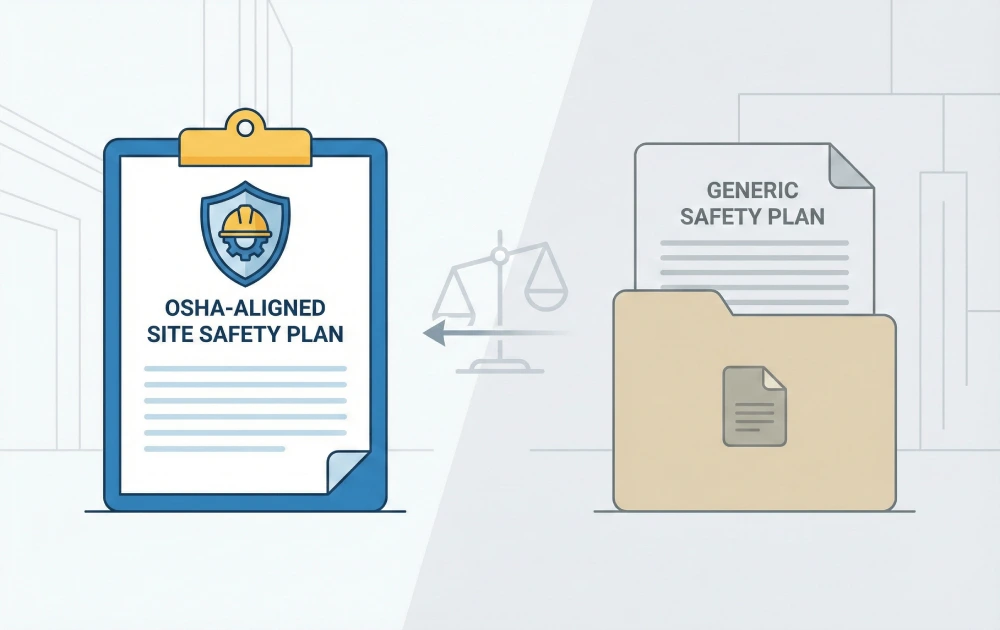
Not All Safety Plans Are Created Equal
You might have a safety plan. But is it actually protecting your workers and your business? Let's examine the critical differences.
What Is a Generic Safety Plan?
Generic plans are templates that aren't customized:
- Downloaded from the internet
- Copied from another project
- Created years ago and never updated
- One-size-fits-all approach
Problems with Generic Plans
They don't address YOUR hazards:
- Your 3-story residential project has different risks than a high-rise
- Indoor vs. outdoor work
- Urban vs. rural site conditions
- Specific equipment you're using
They may be outdated:
- OSHA updates regulations regularly
- Old penalty amounts
- Outdated procedures
- Missing new requirements
They won't survive an inspection:
- OSHA inspectors recognize generic plans
- Questions you can't answer
- Procedures that don't match site conditions
- Evidence of non-compliance
What Makes a Plan "OSHA-Aligned"?
Current Regulation References
An OSHA-aligned plan includes:
- Correct CFR citations
- Current penalty information
- Updated exposure limits
- Latest best practices
Site-Specific Content
Addressing YOUR project:
- Actual site address and conditions
- Specific trades on site
- Equipment actually being used
- Hazards present at YOUR location
Required Elements
29 CFR 1926 requirements addressed:
- Subpart C: General Safety and Health
- Subpart E: Personal Protective Equipment
- Subpart K: Electrical
- Subpart L: Scaffolds
- Subpart M: Fall Protection
- Subpart P: Excavations
- Subpart X: Stairways and Ladders
Side-by-Side Comparison
| Element | Generic Plan | OSHA-Aligned Plan |
|---|---|---|
| Project Address | "Insert address here" | "123 Main St, Suite 100" |
| Hazards | "Fall hazards may exist" | "Fall hazards at roof edge (18 ft), open stairwell (12 ft)" |
| Controls | "Use fall protection" | "Full-body harness with 6-ft lanyard, anchor at parapet" |
| Emergency | "Call 911" | "Mercy Hospital 2.3 miles, Trauma Level II, (555) 123-4567" |
| Training | "Workers will be trained" | "8-hour OSHA training, 4-hour site-specific, daily toolbox talks" |
How Inspectors Tell the Difference
OSHA inspectors look for:
Evidence of Site-Specificity
- "Can you show me where this hazard exists?"
- "Which workers are affected by this?"
- "How was this control measure implemented?"
Current Knowledge
- "What's the current penalty for this violation?"
- "When was this plan last updated?"
- "Have conditions changed since this was written?"
Implementation Proof
- Are workers following the procedures?
- Do conditions match the documentation?
- Can supervisors explain the requirements?
The Cost Difference
Generic Plan
- Upfront cost: $0-50
- Risk: High—may not pass inspection
- Ongoing: No updates
OSHA-Aligned Plan
- Traditional consultant: $2,000-10,000
- SafetyPlanPro: A fraction of consultant costs
- Risk: Low—comprehensive coverage
- Ongoing: Easy to update as conditions change
Don't risk it with a generic plan. SafetyPlanPro generates truly site-specific, OSHA-aligned safety plans customized to your project. Get the protection you need in minutes.