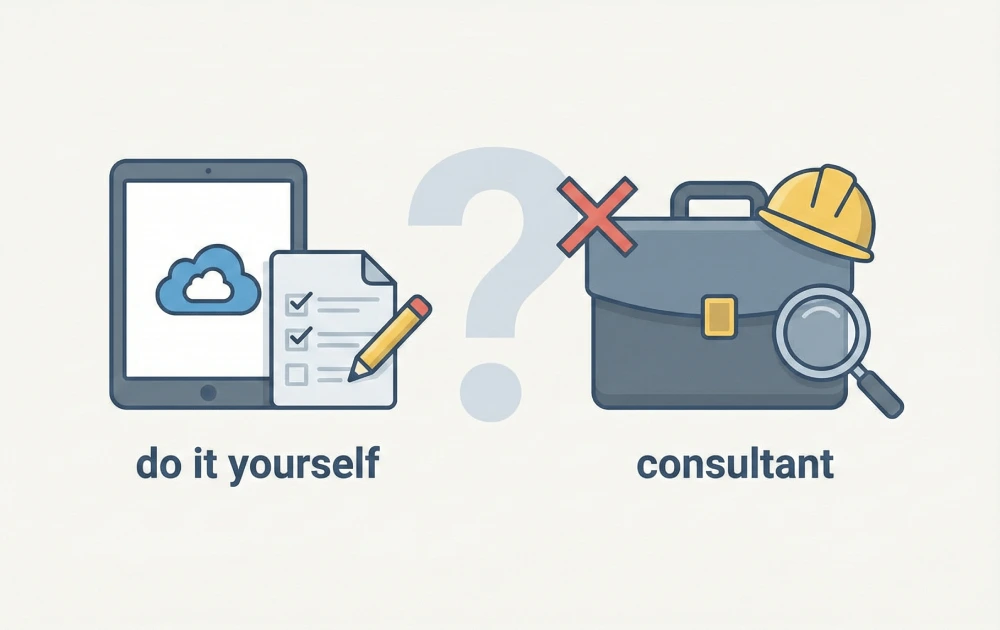
Yes, You Can—And Here's How
Many contractors assume you need an expensive safety consultant to create a compliant safety plan. That's simply not true anymore.
What Consultants Actually Do
The Value of Consultants
Good safety consultants provide:
- Expert regulatory knowledge
- Experience across industries
- Hazard identification skills
- Professional documentation
- Training and implementation support
Why You Might Not Need One
For most construction projects:
- OSHA requirements are well-documented
- Hazards are predictable and known
- Templates and tools exist
- Your site knowledge is valuable
What You Need to Create Your Own Plan
Knowledge Requirements
You don't need a safety degree. You need:
- Understanding of YOUR project
- Awareness of common hazards
- Access to OSHA requirements
- Time to document properly
Resources Available
- OSHA website (osha.gov)
- OSHA Construction eTool
- Industry associations
- Online safety plan generators
Step-by-Step: DIY Safety Plan
Step 1: Document Your Project
Basic information every plan needs:
- Project location and description
- Expected duration
- Types of work being performed
- Number of workers
Step 2: Identify Hazards
Walk through your scope of work:
- What tasks will be performed?
- What equipment will be used?
- What are the environmental conditions?
- What could go wrong?
Step 3: Determine Controls
For each hazard, document:
- Engineering controls (guardrails, ventilation)
- Administrative controls (procedures, training)
- PPE requirements
Step 4: Add Emergency Procedures
Every plan needs:
- Emergency contact numbers
- Nearest hospital location
- Evacuation procedures
- Fire response plan
Step 5: Include Training Requirements
Document what workers need to know:
- Site orientation
- Hazard-specific training
- Equipment operation
- Emergency procedures
Step 6: Create Inspection Checklists
How you'll verify compliance:
- Daily inspections
- Weekly audits
- Equipment checks
- PPE verification
Common Mistakes When Going Solo
Mistake 1: Using Outdated Information
OSHA updates regularly. Make sure you're current.
Mistake 2: Being Too Generic
"Workers will be trained" isn't enough. Specifics matter.
Mistake 3: Missing Required Elements
Each OSHA standard has specific requirements. Don't miss them.
Mistake 4: Forgetting Documentation
The plan is worthless if you can't prove you followed it.
Mistake 5: Never Updating
Conditions change. Your plan should too.
The Easier Way
SafetyPlanPro Advantages
Instead of starting from scratch:
- Answer questions about your project
- System guides you through hazard identification
- Automatically includes required elements
- Generates professional documentation
You still provide the value:
- Your project knowledge
- Your site conditions
- Your specific operations
- Your company information
The system provides:
- Current regulatory requirements
- Proper formatting
- Required language
- Professional output
When You Still Might Need Help
Consider professional assistance for:
- Very complex or unusual projects
- High-hazard operations (demolition, asbestos)
- After a serious incident
- Large, multi-phase projects
- When you lack time to create it yourself
You can create a professional safety plan without a consultant. SafetyPlanPro makes it easy—just answer questions about your project and download your complete, OSHA-aligned plan in minutes. Take control of your compliance today.